Monday, December 30, 2019
Mondays with Laudato Si'- 12/30/19
21. Account must also be taken of the pollution produced by residue, including dangerous waste present in different areas. Each year hundreds of millions of tons of waste are generated, much of it non-biodegradable, highly toxic and radioactive, from homes and businesses, from construction and demolition sites, from clinical, electronic and industrial sources. The earth, our home, is beginning to look more and more like an immense pile of filth. In many parts of the planet, the elderly lament that once beautiful landscapes are now covered with rubbish. Industrial waste and chemical products utilized in cities and agricultural areas can lead to bioaccumulation in the organisms of the local population, even when levels of toxins in those places are low. Frequently no measures are taken until after people’s health has been irreversibly affected.

Monday, December 23, 2019
Mondays with Laudato Si' - 12/23/19
I. POLLUTION AND CLIMATE CHANGE
Pollution, waste and the throwaway culture
20. Some forms of pollution are part of people’s daily experience. Exposure to atmospheric pollutants produces a broad spectrum of health hazards, especially for the poor, and causes millions of premature deaths. People take sick, for example, from breathing high levels of smoke from fuels used in cooking or heating. There is also pollution that affects everyone, caused by transport, industrial fumes, substances which contribute to the acidification of soil and water, fertilizers, insecticides, fungicides, herbicides and agrotoxins in general. Technology, which, linked to business interests, is presented as the only way of solving these problems, in fact proves incapable of seeing the mysterious network of relations between things and so sometimes solves one problem only to create others.
Tuesday, December 17, 2019
Mondays with Laudato Si' (a day late!) 12/17/19
19. Following a period of irrational confidence in progress and human abilities, some sectors of society are now adopting a more critical approach. We see increasing sensitivity to the environment and the need to protect nature, along with a growing concern, both genuine and distressing, for what is happening to our planet. Let us review, however cursorily, those questions which are troubling us today and which we can no longer sweep under the carpet. Our goal is not to amass information or to satisfy curiosity, but rather to become painfully aware, to dare to turn what is happening to the world into our own personal suffering and thus to discover what each of us can do about it.
Monday, December 9, 2019
Mondays with Laudato Si' - 12/9/19
WHAT IS HAPPENING TO OUR COMMON HOME
17. Theological and philosophical reflections on the situation of humanity and the world can sound tiresome and abstract, unless they are grounded in a fresh analysis of our present situation, which is in many ways unprecedented in the history of humanity. So, before considering how faith brings new incentives and requirements with regard to the world of which we are a part, I will briefly turn to what is happening to our common home.
18. The continued acceleration of changes affecting humanity and the planet is coupled today with a more intensified pace of life and work which might be called “rapidification”. Although change is part of the working of complex systems, the speed with which human activity has developed contrasts with the naturally slow pace of biological evolution. Moreover, the goals of this rapid and constant change are not necessarily geared to the common good or to integral and sustainable human development. Change is something desirable, yet it becomes a source of anxiety when it causes harm to the world and to the quality of life of much of humanity.
Monday, December 2, 2019
Mondays with Laudato Si' - 12/2/19
16. Although each chapter will have its own subject and specific approach, it will also take up and re-examine important questions previously dealt with. This is particularly the case with a number of themes which will reappear as the Encyclical unfolds. As examples, I will point to the intimate relationship between the poor and the fragility of the planet, the conviction that everything in the world is connected, the critique of new paradigms and forms of power derived from technology, the call to seek other ways of understanding the economy and progress, the value proper to each creature, the human meaning of ecology, the need for forthright and honest debate, the serious responsibility of international and local policy, the throwaway culture and the proposal of a new lifestyle. These questions will not be dealt with once and for all, but reframed and enriched again and again.
Monday, November 25, 2019
Mondays with Laudato Si' - 11/25/19
15. It is my hope that this Encyclical Letter, which is now added to the body of the Church’s social teaching, can help us to acknowledge the appeal, immensity and urgency of the challenge we face. I will begin by briefly reviewing several aspects of the present ecological crisis, with the aim of drawing on the results of the best scientific research available today, letting them touch us deeply and provide a concrete foundation for the ethical and spiritual itinerary that follows. I will then consider some principles drawn from the Judaeo-Christian tradition which can render our commitment to the environment more coherent. I will then attempt to get to the roots of the present situation, so as to consider not only its symptoms but also its deepest causes. This will help to provide an approach to ecology which respects our unique place as human beings in this world and our relationship to our surroundings. In light of this reflection, I will advance some broader proposals for dialogue and action which would involve each of us as individuals, and also affect international policy. Finally, convinced as I am that change is impossible without motivation and a process of education, I will offer some inspired guidelines for human development to be found in the treasure of Christian spiritual experience.
Monday, November 18, 2019
Mondays with Laudato Si' - 11/18/19
14. I urgently appeal, then, for a new dialogue about how we are shaping the future of our planet. We need a conversation which includes everyone, since the environmental challenge we are undergoing, and its human roots, concern and affect us all. The worldwide ecological movement has already made considerable progress and led to the establishment of numerous organizations committed to raising awareness of these challenges. Regrettably, many efforts to seek concrete solutions to the environmental crisis have proved ineffective, not only because of powerful opposition but also because of a more general lack of interest. Obstructionist attitudes, even on the part of believers, can range from denial of the problem to indifference, nonchalant resignation or blind confidence in technical solutions. We require a new and universal solidarity. As the bishops of Southern Africa have stated: “Everyone’s talents and involvement are needed to redress the damage caused by human abuse of God’s creation”. [22] All of us can cooperate as instruments of God for the care of creation, each according to his or her own culture, experience, involvements and talents.
Monday, November 11, 2019
Mondays with Laudato Si' - 11/11/19
My appeal
13. The urgent challenge to protect our common home includes a concern to bring the whole human family together to seek a sustainable and integral development, for we know that things can change. The Creator does not abandon us; he never forsakes his loving plan or repents of having created us. Humanity still has the ability to work together in building our common home. Here I want to recognize, encourage and thank all those striving in countless ways to guarantee the protection of the home which we share. Particular appreciation is owed to those who tirelessly seek to resolve the tragic effects of environmental degradation on the lives of the world’s poorest. Young people demand change. They wonder how anyone can claim to be building a better future without thinking of the environmental crisis and the sufferings of the excluded.
Monday, November 4, 2019
Mondays with Laudato Si' - 11/4/19
12. What is more, Saint Francis, faithful to Scripture, invites us to see nature as a magnificent book in which God speaks to us and grants us a glimpse of his infinite beauty and goodness. “Through the greatness and the beauty of creatures one comes to know by analogy their maker” (Wis 13:5); indeed, “his eternal power and divinity have been made known through his works since the creation of the world” (Rom 1:20). For this reason, Francis asked that part of the friary garden always be left untouched, so that wild flowers and herbs could grow there, and those who saw them could raise their minds to God, the Creator of such beauty.[21] Rather than a problem to be solved, the world is a joyful mystery to be contemplated with gladness and praise.
Monday, October 28, 2019
Mondays with Laudato Si' - 10/28/19
11. Francis helps us to see that an integral ecology calls for openness to categories which transcend the language of mathematics and biology, and take us to the heart of what it is to be human. Just as happens when we fall in love with someone, whenever he would gaze at the sun, the moon or the smallest of animals, he burst into song, drawing all other creatures into his praise. He communed with all creation, even preaching to the flowers, inviting them “to praise the Lord, just as if they were endowed with reason”.[19] His response to the world around him was so much more than intellectual appreciation or economic calculus, for to him each and every creature was a sister united to him by bonds of affection. That is why he felt called to care for all that exists. His disciple Saint Bonaventure tells us that, “from a reflection on the primary source of all things, filled with even more abundant piety, he would call creatures, no matter how small, by the name of ‘brother’ or ‘sister’”.[20] Such a conviction cannot be written off as naive romanticism, for it affects the choices which determine our behaviour. If we approach nature and the environment without this openness to awe and wonder, if we no longer speak the language of fraternity and beauty in our relationship with the world, our attitude will be that of masters, consumers, ruthless exploiters, unable to set limits on their immediate needs. By contrast, if we feel intimately united with all that exists, then sobriety and care will well up spontaneously. The poverty and austerity of Saint Francis were no mere veneer of asceticism, but something much more radical: a refusal to turn reality into an object simply to be used and controlled.
Monday, October 21, 2019
Mondays with Laudato Si' - 10/21/19
Saint Francis of Assisi
10. I do not want to write this Encyclical without turning to that attractive and compelling figure, whose name I took as my guide and inspiration when I was elected Bishop of Rome. I believe that Saint Francis is the example par excellence of care for the vulnerable and of an integral ecology lived out joyfully and authentically. He is the patron saint of all who study and work in the area of ecology, and he is also much loved by non-Christians. He was particularly concerned for God’s creation and for the poor and outcast. He loved, and was deeply loved for his joy, his generous self-giving, his openheartedness. He was a mystic and a pilgrim who lived in simplicity and in wonderful harmony with God, with others, with nature and with himself. He shows us just how inseparable the bond is between concern for nature, justice for the poor, commitment to society, and interior peace.
Friday, October 18, 2019
All Souls Day - November 2nd

The last holy day of the three day triumvirate of Halloween, All Saints and All Souls, this day focuses on those faithful departed who might not yet be in heaven with all the saints. Catholics believe that those who are destined for heaven but still need to be cleansed of venial sins or, for justice' sake, need to make up for harm they've done on earth, no matter how repentant, must be purged before they can be in the presence of pure good, God. There can be no sin in heaven.
So we have the idea of Purgatory, a place of waiting and purification so that those who are saved can enter heaven. This idea actually has Jewish roots, as it is the ancient custom to pray for the dead. If you have ever prayed the Mourner's Kaddish at a Jewish ceremony, many of the prayers ring true for Catholics.
The way the Church now does things is to call for a day of commemorating the dead, praying for them, and attending Mass for them. It is not a holy day of obligation, but it is a lovely way to remember this feast. My parish has a Mass for all those members of the parish who died that year. I don't attend regularly, but I have attended in years when I have lost family members. It is quite moving.
I am lucky in that I live only 20 minutes from my family's grave site. November 2nd was also my mother's birthday. So I have made it my custom for the last many years to visit the family grave, put flowers on the tombstones and pray a rosary there for them all.
One custom that seems to be gaining popularity is celebrating the Day of the Dead. One year we did make sugar skulls and read about the practice. Since it is not of my own culture (largely Irish Catholic) I don't really focus on this custom. And right now as a zero waster and a no-sugar advocate, the plastic molds for the skulls and the bags of sugar in plastic don't appeal to me whatsoever!
However, I do think it is a meaningful practice to set up an altar someone in the house, with photos of beloved family members who have passed on, and maybe decorate the area with candles, flowers, mini-pumpkins, mementos that remind you of the persons. Including a crucifix, a statue of Our Lday or a rosary or two, etc reinforces the spiritual meaning behind it all.
My parish dedicates the month of November to praying for the dead. We have a book we can enter names into and this book is kept on the altar throughout the month.
Some other suggestions for enriching this holy day:
You might join the clergy in praying the Office of the Dead, a litany of prayers especially for All Souls Day.
Read Dante's Purgatio in the month of November. He was hugely influential in captivating the imagination of our beliefs in the afterlife. His epic is profoundly religious.
Read (now Saint!) John Henry Newman's famous poem, The Dream of Gerontius (much shorter than Purgatio but along the same lines).
Watch the Disney movie, Coco and then read Steve Greydanus' review of the film. This would be best to do with middle to high schoolers.
Monday, October 14, 2019
Mondays with Laudato Si' - 10/14/19
9. At the same time, Bartholomew has drawn attention to the ethical and spiritual roots of environmental problems, which require that we look for solutions not only in technology but in a change of humanity; otherwise we would be dealing merely with symptoms. He asks us to replace consumption with sacrifice, greed with generosity, wastefulness with a spirit of sharing, an asceticism which “entails learning to give, and not simply to give up. It is a way of loving, of moving gradually away from what I want to what God’s world needs. It is liberation from fear, greed and compulsion”.[17] As Christians, we are also called “to accept the world as a sacrament of communion, as a way of sharing with God and our neighbours on a global scale. It is our humble conviction that the divine and the human meet in the slightest detail in the seamless garment of God’s creation, in the last speck of dust of our planet”.[18]
Wednesday, October 9, 2019
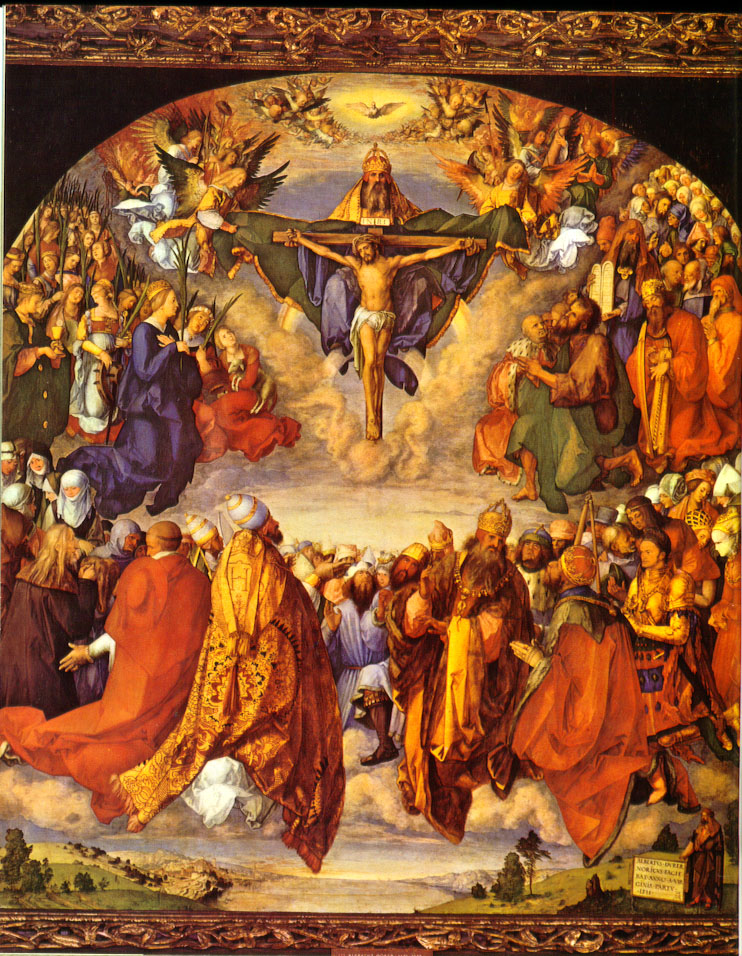
All Saints Day - the reason for the season!
 |
| The Church Triumphant! |
This feast day is actually the highest in the three day sequence of holidays that starts with Halloween. It is a Holy Day of Obligation, so we are obligated to attend Mass on that day. It is to celebrate the Church Triumphant. Here's some suggestions for how to celebrate this feast:
- Go to Mass, of course!
- Attend or host an All Saints party for your children - complete with costumes and games (as low waste as possible!)
- Eat your Halloween candy as part of the celebration
- Learn about your patron saint, your confirmation saint, a saint you are curious about by doing a little research.
- Read saint stories out loud to your children or anybody else who lives with you or is willing to listen!
- Have your kids and yourself give an informal presentation on a saint around the dinner table
- Sing a hymn together that is appropriate for this day or listen to hymns. For All the Saints is a classic! Or Holy, Holy, Holy!
- Pray the litany of the saints
- Play saints bingo! (use recycled printer paper! Print it out once and save it for next year.)
All Saints Day doesn't present the worldliness problems that Halloween has acquired. That's probably why it gets forgotten in the rush. But the focus on the spiritual instead of the world is a nice refresher after the more raucous Halloween. Make it a real focus in your family. The joy of celebrating the saints is a profound one that makes one contemplate the important things, like eternal life, the meaning of life here on earth, what it is to be holy and what it is to love and glorify God.
Monday, October 7, 2019
Mondays with Laudato Si' - 10/7/19
8. Patriarch Bartholomew has spoken in particular of the need for each of us to repent of the ways we have harmed the planet, for “inasmuch as we all generate small ecological damage”, we are called to acknowledge “our contribution, smaller or greater, to the disfigurement and destruction of creation”.[14] He has repeatedly stated this firmly and persuasively, challenging us to acknowledge our sins against creation: “For human beings… to destroy the biological diversity of God’s creation; for human beings to degrade the integrity of the earth by causing changes in its climate, by stripping the earth of its natural forests or destroying its wetlands; for human beings to contaminate the earth’s waters, its land, its air, and its life – these are sins”.[15] For “to commit a crime against the natural world is a sin against ourselves and a sin against God”.[16]
Friday, October 4, 2019
Feast of St. Francis of Assisi - October 4, 2019
ST. FRANCIS OF ASSISI, PRAY FOR US!
 |
| Image from Trinitystores.com |
Wednesday, October 2, 2019
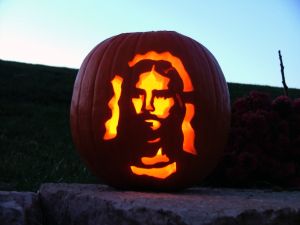
Put the "Hallow" Back in Hallowe'en!
 |
| Image from Catholic.org |
Catholics! Let's take back Halloween! Let's make it about holiness again!
Hallowe'en is an archaic name for holy eve. What is the holy eve it celebrates? All Saints Day of course!
The fact that the secular world focuses more on Halloween than the reason for Halloween shows just how skewed things have gotten.
How to Be a Better Catholic celebrating the triumvirate holidays of Halloween, All Saints Day and All Souls Day:
Halloween has morphed into a commercial holiday that is based on exploitation in one form or another. Let's not go along with this! We can still have fun but keep our priorities straight.
Decorations:
Avoid all the cheap, low grade, plastic tchotchke that is pumped out at a frightening and excessive rate so we can decorate our homes, lawns, classrooms, etc. A lot this stuff is Made in China under horrific working conditions, creating tons of pollution along the way. It's an extremely destructive and ultimately meaningless production of junk. We don't need it to enjoy life and we shouldn't let pressure from corporations and misguided commercial practices take away from our beloved holiday.
What's nice though is at this time of year, nature, at least in the northern hemisphere, provides a lot of natural ways to decorate. So paint your pumpkins, carve your Jack O' Lanterns, stuff your own scarecrows using straw and old ratty clothes, line your driveway with reusable lanterns or candle holders. Make your own front door wreath or sign or buy from a local artist. Go to your local corn maze, bonfire, apple picking event. Make Halloween and all things Autumnal more about nature than commercial excess.
Costumes
Don't buy chintzy, plastic or polyester costumes for your kids. Instead have a real dress up box of second hand clothes or items made from natural fibers that the kids can turn into whatever they want. Or if you are good at sewing, make your own. For instance, one brown robe can be the basis for many different costumes. You want various articles of clothing that are versatile and can used to make all sorts of different costumes. Take your kids second hand shopping to help them make their own costume. And here is a really important Catholic element that will bring real depth of meaning to your Halloween. Let the kids dress up as saints! In my own family, often we would dress up as one thing on Halloween (like a princess or a knight) and then use the same costume the next day for an All Saints party (like St. Elizabeth of Hungary or St. George). The whole reason for Halloween as I said before, is to prepare for the high holy day (of obligation, btw) of All Saints Day! Dressing up as saints is extremely on point here!
Dealing with the Spooky Aspect
If you are chary of spooky stuff because it's got a bad vibe to you, due to adults turning folk fun into Satanic or demented sordidness, you don't have to go that way at all. Just celebrate the autumn and saints. No judgment here!
If you, like me, rather enjoy spooky stories and old timey ghost stories, fairy tales, etc then have fun with it but be aware that some elements in society have hijacked this into rather nefarious channels. When my kids were younger, I liked to use this time of year to explore literature that somehow resonated with the autumn months. To me, it's about discernment. There is lots of classic stuff to read with your family to deepen your enjoyment. Oscar Wilde's The Canterville Ghost, The Headless Horseman by Washington Irving, Edgar Allan Poe poems and short stories, Hamlet and MacBeth are perfect plays to read for this season. Sherlock Holmes stories, Agatha Christie short stories, G. K. Chesterton Father Brown stories. And for younger kids, just reading fairy tales is fun.
Candy:
Here's a list of some ideas for a zero waste Halloween. I don't go along with the one suggestion that you just try to find candy that is still wrapped in cardboard boxes like Milk Duds. First of all, they are tiny boxes and I don't know if they actually make it into regular paper recycling. And they might contaminate the recycling anyway because of melted chocolate. So you can't really recycle them, I don't think. You could compost though. However, the other thing that bothers me even more is that Hershey is notorious for buying chocolate from the commodities market where they have a deliberately opaque supply chain that probably involves very bad labor practices. Why do we want to support a company that has been exploiting developing countries and children to make its vast fortune? That doesn't feel very saintly to me! I mean Milk Duds and Junior Mints just aren't that important to me when I think about it that way.
I honestly think we teach kids gluttony when we deluge them with candy. We do it starting well before Halloween and pretty much continuing it through Christmas. (With maybe a brief break until Valentine's Day starts it up again). We are really doing a major disservice to our kids in a very misguided, negligent way by letting the candy producers own our consciences because we ourselves are weak and addicted and don't have good judgment. Kids are obese and diabetes at younger and younger ages is skyrocketing. We are literally damaging our children's health and endangering their lives because we have so little self-control.
Let's make this about God instead. When we put Him first, things always shake out the way they should. To be zero waste one often has to plan ahead. Some alternatives for trick or treaters:

- Equal Exchange chocolate from Catholic Relief Services and give that out. It's pricey so you won't be tempted to go overboard. And you'll know that your money went to help the less fortunate.
- Hand out things like mandarins with jack o lantern faces. I did this one year and the kids thought it was cute.
- As in the linked suggestions, come up with another non-candy treat to hand out.
To me, a Catholic consumer wants to be educated and make their shopping choices based on Christian teachings. Excessive, reckless consumption might be the zeitgeist of living in the USA today, but it doesn't align with what is truly meaningful to me.
Making Holy Eve about Holiness:
As Catholics, why don't we make going to confession and adoration part of the lead up to Halloween? We are preparing to honor all the saints in heaven and on All Souls' Day we are praying for the dead. Shouldn't we make the beautiful gifts of the sacraments part and parcel of this preparation? The sacrament of Confession cleanses us of our sins (at least until we sin again!) and Adoration centers our prayer life in Christ's gift of the Eucharist. This year, 2019, the Saturday before Halloween is October 26th. Put it on your calendar to go to confession. Or if you have a parish around you that has weekday confession, go for it.
To be continued . . . .
Monday, September 30, 2019
Mondays with Laudato Si' - 9/30/19
United by the same concern
7. These statements of the Popes echo the reflections of numerous scientists, philosophers, theologians and civic groups, all of which have enriched the Church’s thinking on these questions. Outside the Catholic Church, other Churches and Christian communities – and other religions as well – have expressed deep concern and offered valuable reflections on issues which all of us find disturbing. To give just one striking example, I would mention the statements made by the beloved Ecumenical Patriarch Bartholomew, with whom we share the hope of full ecclesial communion.
Monday, September 23, 2019
Mondays with Laudato Si' - 9/23/19
5. Saint John Paul II became increasingly concerned about this issue. In his first Encyclical he warned that human beings frequently seem “to see no other meaning in their natural environment than what serves for immediate use and consumption”.[4] Subsequently, he would call for a global ecological conversion.[5] At the same time, he noted that little effort had been made to “safeguard the moral conditions for an authentic human ecology”.[6] The destruction of the human environment is extremely serious, not only because God has entrusted the world to us men and women, but because human life is itself a gift which must be defended from various forms of debasement. Every effort to protect and improve our world entails profound changes in “lifestyles, models of production and consumption, and the established structures of power which today govern societies”.[7] Authentic human development has a moral character. It presumes full respect for the human person, but it must also be concerned for the world around us and “take into account the nature of each being and of its mutual connection in an ordered system”.[8] Accordingly, our human ability to transform reality must proceed in line with God’s original gift of all that is.[9]
Monday, September 16, 2019
Mondays with Laudato Si' - 9/16/19
4. In 1971, eight years after Pacem in Terris, Blessed Pope Paul VI referred to the ecological concern as “a tragic consequence” of unchecked human activity: “Due to an ill-considered exploitation of nature, humanity runs the risk of destroying it and becoming in turn a victim of this degradation”.[2] He spoke in similar terms to the Food and Agriculture Organization of the United Nations about the potential for an “ecological catastrophe under the effective explosion of industrial civilization”, and stressed “the urgent need for a radical change in the conduct of humanity”, inasmuch as “the most extraordinary scientific advances, the most amazing technical abilities, the most astonishing economic growth, unless they are accompanied by authentic social and moral progress, will definitively turn against man”.[3]
Subscribe to:
Posts (Atom)
-
Right now, at this point in my life, I am an Ethical Omnivore. Long time ago I was a vegetarian for a few years, but being married to a...
-
This video has some great thoughts and asks some interesting questions about the role Christian morality plays in 'prosperity' by wh...
-
2. This sister now cries out to us because of the harm we have inflicted on her by our irresponsible use and abuse of the goods with which ...
